

Planning summary and the validation process
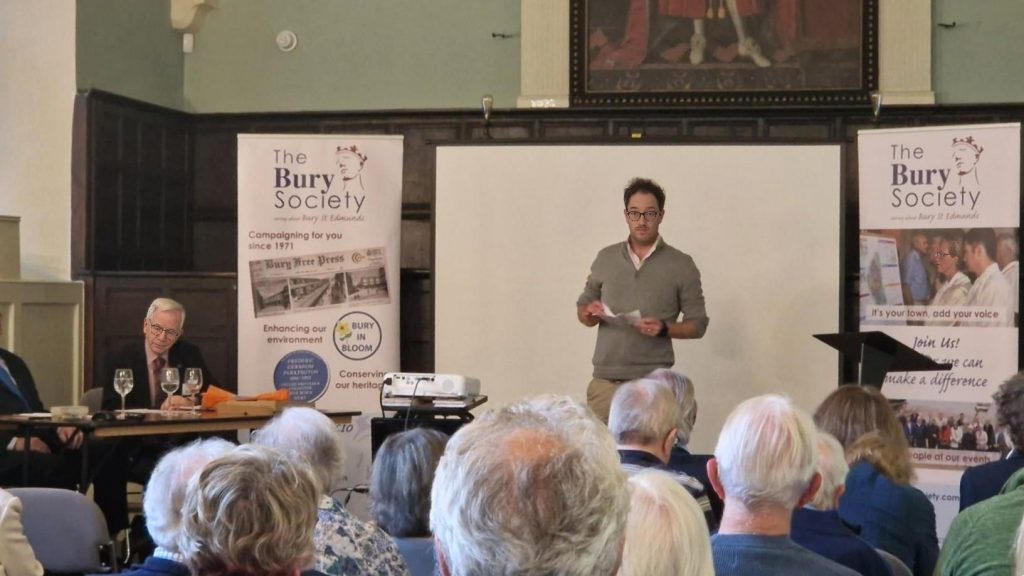
From a report at this year’s AGM by Ed Thuell our Planning Officer
Each month The Bury Society CIO continues to review all applications within Bury St Edmunds.
We are specifically looking for applications that in some form directly impact the heritage of the town, its built environment and characterisation of the conservation areas and their surroundings.
Development can of course have both a positive or a negative impact and occasionally both. With our comments we look to support applications which we feel are an enhancement or a benefit to Bury St Edmunds and its residents and oppose applications which we feel will have a detrimental impact, in whichever form this may be.
Regarding some key applications over the last year, we opposed the demolition of the station hill water tower at the railway station, which was part of the response that ultimately saw this application refused.
We, along with local residents, opposed the appeal for the Cornhill site development and we’re pleased to see that this was also rejected.
We supported the proposed enhancements to the Cathedral and Abbey Precinct Visitor Experience. However we did raise concerns with the design of the Visitor Centre, ultimately these concerns were dismissed but we are excited to see the next step in the development of this significant feature of the town.
We are pleased to see that the detailed application for the hospital has now been submitted and hope that this will be another step forward in delivering high-quality services to the town.
We resisted the application to develop the former St. James’s Middle School site on the eastern bank of the River Lark, alongside the Abbey of St Edmund Heritage Partnership. Our concerns here were that the proposed development did not consider in enough detail the possible impact on the Abbey Precinct and the heritage setting of this development. Whilst the development site had obvious merits. We felt that these heritage concerns, we’re not fully appreciated, or mitigated. This was particularly apparent whilst watching the Local Planning Committee meeting discuss the subject.
As well as these we continue to represent our members commenting on and reviewing a wide variety of other planning and listed building applications. In monitoring these applications it is possible to notice themes and trends, both in respect of the types of applications and the council’s position.
We are seeing what could otherwise be perfectly legitimate applications and proposals being submitted to the local authority but with the bare minimum level of information provided. These are applications that may be submitted without drawings, clearly identifying the location of the works, material specifications, and detailed schedules of works to illustrate how the works will be undertaken. Heritage statements that do not delve into the real detail of a property and assess the impact of works. The danger is that this leads to miscommunication or a lack of understanding of the proposed works by the applicant, consultees and the general public when reviewing them.
Not only are these applications being submitted with this level of information some are being approved. We understand that the conservation officer and the local planning department review applications and they are determining that the information provided is satisfactory but in our view in some of these instances we’re seeing applications for works approved which just shouldn’t be without clear detail and justification.
This is something we are carefully monitoring and each time the occasion arises we are making representations directly to the planning officers and in the public forum in the hope that this will improve the validation process. This is a key aspect of any planning system. All applications should be judged on the same level of information, irrespective of the level and scope of works. If this information is missing, then we fail to understand how an application can be considered and determined accurately and without possible harm to the heritage asset and its setting.
There is throughout Bury St Edmunds both in the centre and expanding outskirts a great deal of change now and in the future, comprised of both subtle adaptations and larger more significant alterations. Now it is as important as ever that high standards and careful scrutiny should be applied.
Warning: Array to string conversion in /home/burysociety/public_html/wp-content/themes/loki/functions.php on line 226
Array
Related Articles

Summary of planning issues 2023-mid 24
Ed Thuell, our Planning Officer, summarised recent planning work at the 2024 AGM in June Since taking on the...

Cornhill Walk Appeal Hearing: February 8, 2021
The Bury Society’s big event of the year was putting together a very strong objection to the Appeal by...

Planning Update, November 2020
The Society responded to several applications in October and November and these are summarised here. The Society also wrote...